
Natural disasters
Earthquakes, typhoons and floods take down base stations and cut power. Phone and internet services stop for days or weeks, precisely when coordination decides outcomes.
On-device AI · Locally accessible cloud
A portable communication platform that runs AI on the device itself — speech recognition, translation and intelligent alerting that keep working with no cell tower, no internet and no mains power. The moment a link returns, everything syncs to the cloud.
Compliant with ITU-T L.392 · Field-trialled in the Philippines, Japan and Nepal
The problem
Most communication tools quietly assume a network is nearby. In a disaster, that assumption fails first — and it fails for days.
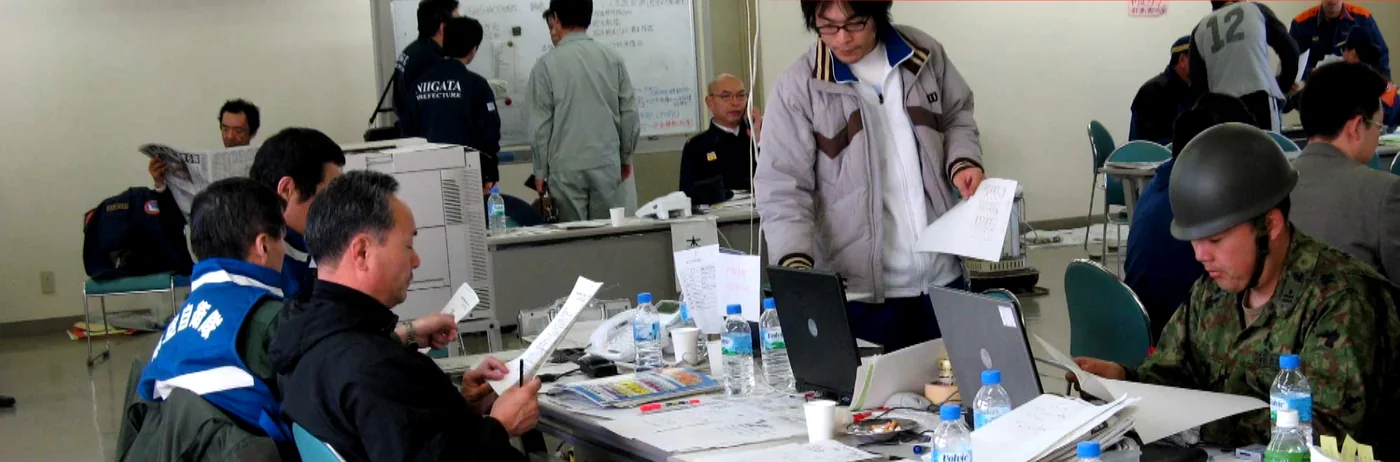
Earthquakes, typhoons and floods take down base stations and cut power. Phone and internet services stop for days or weeks, precisely when coordination decides outcomes.
Islands, mountains, mines, forests and offshore sites sit permanently outside reliable coverage. Teams there work without the coordination tools everyone else assumes.
When the link drops, damage and casualty reports stop flowing upward. Resource allocation and rescue prioritisation stall — not for lack of will, but for lack of information.
The solution
Open the case, power on, and a local network is live within minutes. Staff connect with the phones and tablets already in their hands — no special hardware, no training in new devices.
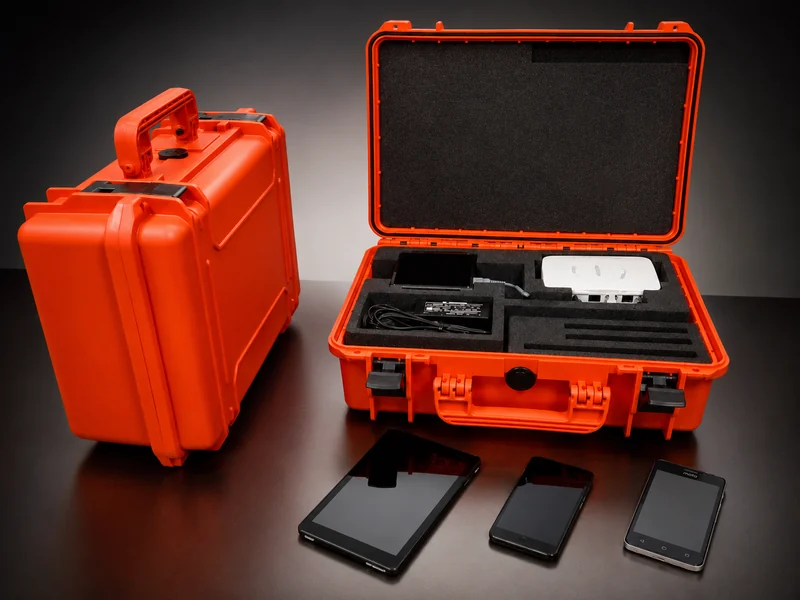
How it works
Solar panel by day, 8-hour battery reserve by night or under heavy cloud. A unit runs indefinitely in places with no grid power at all.
Solar + 8 hrs · 24/7
Digital messages travel over the air with no SIM, no Wi-Fi and no tower. Range is set by the radio you attach — hundreds of metres on a handheld, kilometres on amateur or LoRa.
421 m handheld · 1,180 m+ LoRa · ~3 km HAM
Speech recognition and speech synthesis run on the device itself, with no internet connection. Say “Hello Max” and raise an alert hands-free — vital when hands are busy, it is dark, or a device cannot be safely held.
Offline ASR · TTS · translation · intent
Built for
What these have in common is a moment when the network is gone and coordination still has to happen.
Keep the damage-reporting chain intact when towers and power go down, and reach residents with alerts that do not depend on the mobile network.
See the use casesMines, offshore sites, forestry and construction far beyond coverage — safety monitoring and team coordination without waiting for infrastructure.
See the use casesServe learning platforms and local information from the unit itself, so unreliable connectivity stops being the limit on what a community can do.
See the use casesLocal and cloud, as one
This is the part most resilient-comms products miss. Vicino AI is not a fallback you switch to in an emergency — it is the platform you use every day, which happens to keep working when everything else stops.
Operates fully offline, stores data on site, and serves the local team directly. Syncs upward whenever a connection appears — even briefly.
Aggregates data from many field units into one shared picture for coordinators and command centres. Provincial and national consolidation resumes automatically.
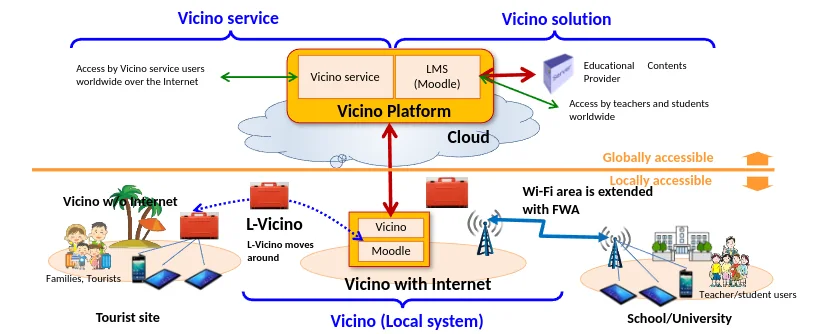
Because it is useful every day — for regional information, drills and training — utilisation is high and the investment justifies itself, rather than sitting in storage waiting for a disaster.
Evidence
Feasibility trials in Cebu and Cordova demonstrated local connectivity for disaster response and education in real island conditions.
Deployments focused on disaster preparedness and response, improving communication continuity during natural disasters.
Trials in remote and underserved areas provided reliable local networks for education and community development.
Vicino AI conforms to ITU-T L.392, the recommendation for disaster management using movable and deployable ICT resource units (MDRUs), approved in April 2016. Standards compliance is what separates a prototype from procurable infrastructure.
IGF 2023
Showcased Vicino's role in digital inclusion and disaster resilience at the Internet Governance Forum in Kyoto.
UN ESCAP
Presented Vicino's contribution to the Sustainable Development Goals and community resilience in disaster-prone areas.
APNIC Foundation
Collaborating on a project to improve internet access and digital literacy in underserved regions.
APCTT Tech Monitor
Featured for its approach to disaster preparedness and continuous connectivity during emergencies.
Partners

Advanced Telecommunications Research Institute International, where the LACS concept originated. Neiglobe holds a licence from ATR for LACS and develops Vicino AI as its commercial edition.

Philippine foundation deploying Vicino across the Visayas, with working relationships spanning 44 municipalities in Cebu Province.

Engineering partner contributing specialist capacity to platform and AI development under Neiglobe direction.

Philippine Department of Science and Technology regional office, partner for scientific cooperation and public-sector engagement.

Bringing localised connectivity to remote schools in Nepal, extending educational opportunity where infrastructure has not reached.

Rural broadband specialists, partnering to extend the reach of Vicino AI into underserved regions.

Systems collaboration on reliability engineering as demand for dependable communication networks grows.

Strategic advisory supporting delivery into underserved regions.
We run live field demonstrations tailored to your environment — your terrain, your failure modes, your team.