
Skip to content
neiglobe

Technology

Bringing the cloud to where the network isn't.

Vicino AI implements the Locally Accessible Cloud System (LACS) architecture: rather than restoring a link to distant servers, it brings the service functions physically into the affected area.

Where the infrastructure breaks

People reach the internet through an access network of base stations and fibre, connected onward through communication buildings and a transport network to distant data centres. In a disaster, the access network fails first — base stations lose power, fibre is cut. In a large-scale event, communication buildings and transport networks are damaged too. Everything downstream stops.

  1. 01

    Access network

    Base stations, fibre

    Fails first

  2. 02

    Transport network

    Communication buildings

    At risk in large events

  3. 03

    Internet / data centres

    Distant services

    Intact but unreachable

Diagram of possible damage to ICT infrastructure under disaster conditions, showing access network, communication buildings, transport network and data centres.

Figure 1. Possible damage to ICT infrastructure under disasters

The LACS architecture

LACS is a portable system that temporarily forms an internet-like environment in its surrounding area, delivering ICT services locally. People near the unit use their own smartphones to collect and share information and to reach family and colleagues. The core idea is to move the service functions to the local area and integrate them with whatever access network survives or is newly deployed.

The LACS concept: a portable unit forming a temporary internet-like environment in the surrounding area, with people connecting by smartphone.
Figure 2. Locally Accessible Cloud System concept

Research origin

The LACS concept was proposed in 2019 by Dr. Toshikazu Sakano, a director at the Advanced Telecommunications Research Institute International (ATR) in Kyoto. A prototype was developed and a series of feasibility studies conducted with support from Japanese Government R&D funding. Neiglobe holds a licence from ATR for LACS and develops Vicino AI as its commercial edition.
ITU-T L.392

Approved in April 2016, ITU-T Recommendation L.392 addresses disaster management for improving network resilience and recovery using Movable and Deployable ICT Resource Units (MDRUs) — collections of ICT resources packaged as portable units that can be rapidly deployed to substitute damaged network facilities. Vicino AI conforms to this recommendation and can be classed as a Network-in-a-Box solution.

Read the recommendation
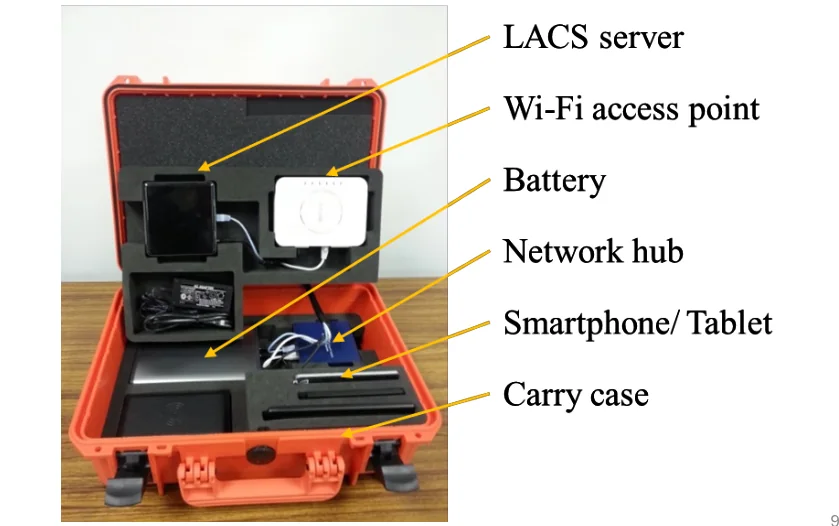
The LACS pilot unit — a case holding a small server, Wi-Fi access point and battery.
Figure 3. The LACS pilot unit
Table of typical LACS specifications.
Table 2. Typical specifications
Table of expected LACS use cases.
Table 1. Expected use cases

References

  1. [1]T. Sakano et al., "Disaster-Resilient Networking: A New Vision Based on Movable and Deployable Resource Units," IEEE Network, vol. 27, no. 4, pp. 40–46, Aug. 2013. DOI ↗
  2. [2]T. Sakano et al., "Bringing Movable and Deployable Networks to Disaster Areas: Development and Field Test of MDRU," IEEE Network, vol. 30, no. 1, pp. 86–91, Jan. 2016. DOI ↗
  3. [3]Recommendation ITU-T L.392, "Disaster management for improving network resilience and recovery with movable and deployable ICT resource units," April 2016. ITU-T ↗
  4. [4]R. Teng, T. Sakano and Y. Suzuki, "Instantaneous Networking Service Availability for Disaster Recovery," Appl. Sci. 2020, 10(24), 9030. DOI ↗
  5. [5]T. Sakano, B. Ojetunde, Y. Suzuki, J. N. Llanto and C. Sharma, "Feasibility study of Locally Accessible Cloud System (LACS) conducted in a remote island in Cebu, Philippines," 2nd International Symposium on Disaster Resilience & Sustainable Development, June 2021.
  6. [6]B. Ojetunde, S. Ano and T. Sakano, "A Practical Approach to Deploying a Drone-Based Message Ferry in a Disaster Situation," Appl. Sci. 2022, 12(13), 6547. DOI ↗

See it work where nothing else does.

We run live field demonstrations tailored to your environment — your terrain, your failure modes, your team.